
There is a group of 41 psychopaths in D.C. and they have taken hostages. There ransom note says their demands need to be met before December 31. Time is running out, they refuse to negotiate. There is no way to reach an agreement in time what do you do.... What do you do!
The answer is you shoot the hostage. In D.C., you might have heard, there is a hostage situation going on. The American people are being held hostage. If we let the bush taxes expire millions of Americans will see their taxes go up, not a lot, on average about $3000 dollars over the course of a year, which adds up to about $60 dollars a week. Believe me I understand 60 dollars is enough to feed a family for a week. I also understand that more than half of the tax cuts go to aid the middle and lower class. I also realize that next year the republicans would have offered a much much worse proposal than what was passed. I’ve thought long and hard on this and as much as it would pain me to not have that money it pains me more to let the criminals get away with this.
In a lot of ways what I do with this blog is pull together a week or two of what at first glance seems like disparate information and try, often unsuccessfully, to pull together what I feel is a coherent narrative. These weeks have been a remarkable collection of noteworthy moments that I feel bring into sharp focus what is really going on in the world today. Frankly though I don’t feel I can smooth out the edges of these stories enough to slink them together in a neatly ordered essay. So forgive me for the admittedly rambling anecdotal paragraphs forthcoming I promise I will pull it all together in the final paragraphs to what I feel is the crux of the problem liberals have with the tax deal.
Maybe paying retail isn’t so bad
Recently I eavesdropped in on a conversation on the difficulties of running a truly small business. Businesses sell stuff obviously but in order to sell stuff they need a store front, a building to store the stuff and have people come and pick it up. You have to pay rent and utilities and you have to pay staff. All of that before you get to take any money for yourself. Of course all this makes sense and we all know this, but I never made the connection to this and sales. Almost everything goes on sale if you wait long enough; the frugal shopper knows this and waits until things are on sale for these moments to buy stuff. We all know this and for a lot of us it is really the only way to get by, but personally I never really thought about the mechanics of a sale. Mostly I always thought of price markdowns as a reflection of true costs of a product and the 20% was profit that companies were “raking in.” I never took into consideration the considerable risk companies take every day. To illustrate that point I had to remember a moment in my childhood.
When I was a wee lad I had a game on my apple IIe. It was a hot dog stand game, the point of the game was to figure out how many hot dogs, sodas, and peanuts to buy and how much to sell them for a week before a ball game. If you bought too much you’d have to throw product away and take a loss, if you priced too high customers would complain and you wouldn’t sell enough to cover costs and again you would take a loss. A fairly straight forward game, but in the game you started with a considerable bank account and all of your losses came from their. Much like in monopoly the game never dealt with the possibility of operating in the red.
Operating in the red is something people generally forget about. I don't have any real numbers on this but I think it is fair to say that on a monthly basis most small businesses operate somewhat in the red, just to pay the bills and meet payroll. What does any of this have to do with sales? Well when you go into a store a fair amount of what you see on the shelves isn't paid for. What I mean is generally stores buy what they sell on credit. They are betting that within roughly 90 days they will be able to sell enough stuff to pay back all their loans. When things go on sale what it generally means is the company lost their bet and now in order to stop paying interest they need some money even less then they need to keep the lights on just so they don't fall into debt. The thing is most companies also need to make this same bet on their workers wages. In other words sales are often done to make sure the lights are kept on and the workers get a pay check at the end of the week. This realization really put the Banking crises into a new perspective. I knew that the crises froze up credit, and that it had an effect on small businesses. Now I see why small businesses even successful ones rely on credit to have product and make payroll. The sad fact is while the banking industry received tons of support most of the What Austerity really looks like:
 |
| Guardian UK |
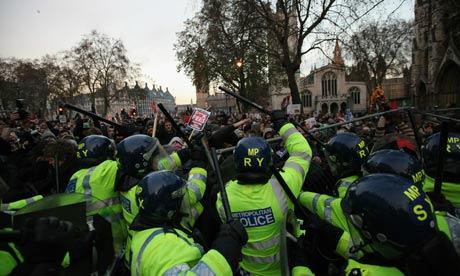
You may not have heard about it but there were protest in England over the crushing austerity measures being put forth by the conservative-lib-dem coalition government in charge right now. The fracas actually exploded into pockets of violence with police and protesters attacking each other. Even the royal family was caught in the onslaught of civil unrest. What sparked the protest was a three-fold increase in university fees. I’ve talked railed on this subject before the notion that governments can just cut the non-essentials and balance their budgets is ludicrous. Governments cannot generally get away with wasting tax payer money on completely non-essential tasks. Sure there is absolutely government waste it is not however a result of the government doing things people don’t need them to do. The majority of government waste is a result of poor, and more regularly politically motivated management. Decisions are often made with the photo op in mind as opposed to the effectiveness. As a result more costly choices are chosen in lieu of longer lasting more frugal choices.
Respect the gears of production
This brings me to a major point of contention. Government employees are living under Blitzkrieg. The federal government has announced it will freeze all employee salaries and States are threatening to abandon their pension obligations. The result, while there are minor signs of private sector job growth that are completely negated by the loss of government employees. A lot of hoopla has been made about ballooning government an obviously it is true that the amount of government employees keeps on rising as this graph shows:

Except in terms of the population they are serving for the last thirty years the amount of government has in most cases tracked pretty consistently with population growth, with one notable exception federal workers. As the graph shows the amount of federal workers per capita has decreased:

Under all but some of the rarest circumstances government employees on average gets paid less then their private sector counter parts. This does little to encourage the best and brightest to government service. Couple this with an increasing vendetta by some in politics and the media and the result will be less effective government.
The Elephant in the room is the 50 state Budget crises
Speaking of less effective government Governor Chris Cristie has cancelled a New York/New Jersey rail project. The project would have brought jobs to both states, improved the capacities of a rail system that hasn’t seen any significant investment in over 50 years, and reduced congestion during peak hours. At the same time Governor Jan Brewer has cut the Medicaid organ donor program effectively creating the often feared “government death panel.” Both Governors point to budget short falls as the reason. The real estate meltdown affected home owners and businesses, these often overshadowed the losses state and local governments faced due to the dramatic drop in revenue. Unlike people and business, states can’t move for better economic opportunities. If the reason we rescued the banking industry and the auto industry is because they were too big to fail then where is the lifeline for California? How about Texas? For people in favor of state power, and believe that states are more capable at managing thing then the federal government shouldn’t a boost in their coffers during their roughest time be wildly supported.
It is being portrayed that while our recovery is shaky the recovery has truly begun. Frankly we are more vulnerable now than we’ve ever been. In the midst of all the changes that are going on, now is not the time to celebrate. Not to be to hyperbolic but the future of the country will be decided during this country. What these stories illustrate is how the culture will be changed and affected by the sacrifices some of us have to make. The tax deal has the potential to erode the foundation of what has given us much of the prosperity we enjoy today. At the same time it fails to address the true nature of our hobbling recovery. While I'm thankfully help is on the way for so many of the unemployed, and that my taxes will not be increasing presently, I still feel that it was mostly policy aimed in the wrong direction.


No comments:
Post a Comment